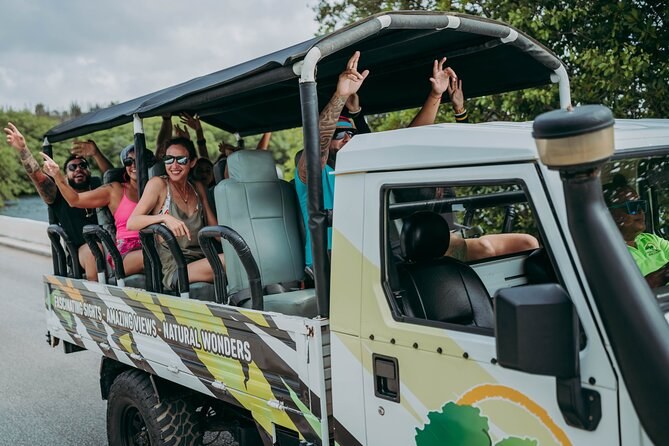
Aruba Signature Jeep Tour: Natural Pool and Baby Beach
Pass paid at check-inLocal guideMax 12
From $78 per person
Fifteen bookable days go into Arikok National Park, from seventy-eight dollars for a seat to six hundred for a private vehicle. Nothing on the open web sorts them by anything except price, and price is close to the last thing that should decide it. The number that actually matters is how long each one spends inside the boundary, and almost nobody publishes that.
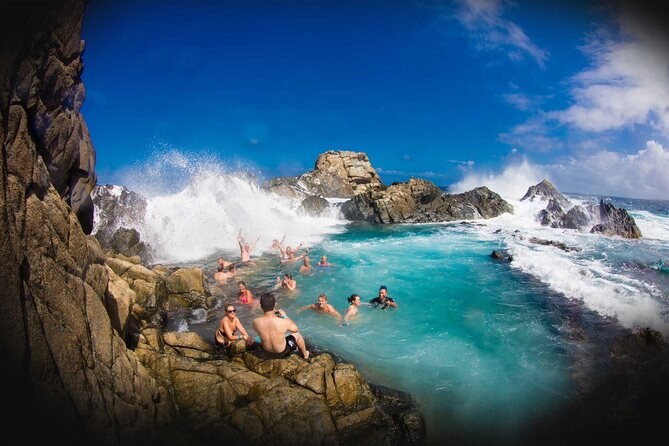
This is the first fork and it settles more than any other question. Conchi — the Natural Pool — is a rock basin on the windward coast, walled off from the open sea, and it is the photograph that brought most people to this page. It is reachable on foot, on horseback or by 4x4 and by nothing else, because the last stretch is an unpaved rock track that Aruban rental agreements routinely exclude from their insurance.
If Conchi is the point of your day, you are booking a guided vehicle, and the only remaining questions are which one and for how long. If it is not — if the caves, the dunes and the windward coast are enough — you can buy a US$22 pass, drive yourself in and have a good half day for the cost of admission and petrol. The self-drive guide covers that version properly.
Here is the figure the listings bury. A four-and-a-half-hour tour is not four and a half hours in the park: it is pickup, drive, park, drive, drop-off, and on several of these the park is the smaller half. The spread across the set runs from a quarter of an hour inside the boundary to four hours.
Read off each listing's own itinerary stop times at capture. The fourth column is the one that separates them.
| Tour | Fare | Total length | Time inside the park |
|---|---|---|---|
| Aruba: Arikok National Park Jeep Safari | From $109 per person | 4 hours | Four hours, all of it in the park |
| Private Jeep Tour National Park | From $299 per person | 6 hours | Three and a half hours, plus the named stops |
| National Park Arikok Jeep Safari Adventures | From $85 per person | 2 to 6 hours | Two hours, plus six named stops |
| Aruba Natural Pool and Indian Cave Rugged Jeep Safari | From $99 per person | 4 hours 30 minutes | Three hours, an hour of it at Conchi |
| Aruba Signature Jeep Tour: Natural Pool and Baby Beach | From $78 per person | 4 hours 30 minutes | An hour and a quarter, plus Fontein Cave |
| Aruba Arikok National Park Jeep Safari: Natural Pool & Baby Beach | From $95 per person | 5 hours | About an hour |
| Aruba Outback Safari Jeep Tour - Lighthouse, Arikok & Conchi Pool | From $121 per person | 4 hours 30 minutes | Half an hour inside a wide island circuit |
| Aruba: 4x4 UTV Off-Road Adventure Tour | From $90 per person | 4 hours | None — a north-coast circuit outside the boundary |
Three vehicle classes, and they are not interchangeable.
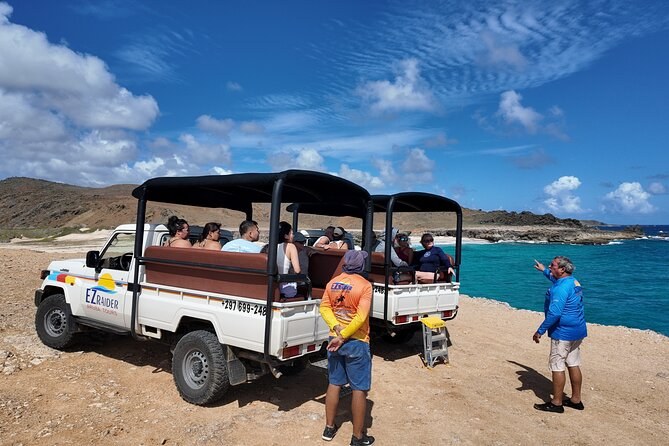
A shared jeep is a seat in an open 4x4 with eight to twenty other people, on a fixed route at a fixed time, from seventy-eight dollars. Somebody else drives, nobody needs a licence, and it is the only class the park still admits all the way to Conchi. Most of the set is this.
A private jeep is the same vehicle with nobody else in it. Two of the three are priced per vehicle rather than per seat — six hundred dollars for up to four or five travellers — which means the arithmetic flips somewhere around four people. The third is priced per seat and is expensive for what it is. The private tour page does that sum in full.
A UTV is a side-by-side you drive yourself, with a licence, in convoy behind a guide. The thing nobody tells you before booking is that the UTV cannot enter Arikok at all: the park banned the class on 31 October 2020, and ATVs the June before. So a UTV day either stays outside the boundary or transfers you into a jeep at the gate. The UTV page is blunt about which does which.
Sometimes, and it is worth two minutes to check. The Aruba Conservation Foundation charges US$22 per person, under-17s free. Several listings have that inside the fare; several state it in their own exclusions and take cash when you check in. That second group is where the complaints come from — not because the fee is unfair but because it arrives unannounced.
Three patterns, and they matter more than they sound. Some operators collect from your resort lobby on Palm Beach or Eagle Beach, which is the easiest arrangement if you are staying on the strip. Two meet at their own offices in Oranjestad, which suits anyone downtown or arriving on a ship and means a taxi if you are not. One works from a ranch at Paradera in the middle of the island, and one lists forty-five hotels by name.
If you are on a cruise, the Oranjestad meeting points are within reach of the terminal. One listing states that it cannot carry passengers from a particular line, which is the kind of thing to read before you pay rather than after.
Four to five hours is the standard shape and it is about right for a first visit: the park, the pool, a cave and a swim to finish. Six hours adds either more park stops or more island, depending on the operator, and eight is only worth it if you want the whole coast rather than the park.
Two hours exists as a grade on one listing and it is not enough to reach Conchi and come back. If you see a very short duration, check what it actually covers before you assume it is the same day in less time.
This is the question that quietly decides more bookings than price. The track inside the park is rough by design, and travellers describe being thrown about — usually with affection, occasionally not. Every operator states that their day is not recommended with back or neck trouble, and one reviewer's advice is simply to tie your hair up.
If somebody in the party will not enjoy that, the answer is not a different jeep. It is the graded road: drive yourself to both caves and Boca Prins in an ordinary car, or take the guided walk up Arikok Mountain, which covers the same country at walking pace and finishes with a swim.
Under-17s pay nothing for the conservation pass, which makes this one of the cheapest family days on Aruba. The caves are the part children remember. The two things to weigh are the roughly ninety-three steps down to Conchi and the length of the track, and one listing sets a minimum age of four with no infant seats carried. Two operators do carry infant seats and two accept strollers.
Depends on one thing: whether you came for the park or for a day out with a swim in it.
More than it sounds. The caps in this set run from eight travellers to eighty, and two jeeps at the same stop with eight and with forty people in them are not the same experience: one gets the pool to itself for twenty minutes, the other queues for the steps. Reviewers on the small-cap listings say so directly, and reviewers on the big ones mention crowding at the stops rather than on the vehicle.
The cap is also a proxy for how the day is run. A twelve-seat operation is usually one guide who drives, narrates and takes your photograph; an eighty-traveller operation is a fleet with a briefing. Neither is wrong, and the price difference between them is smaller than you would expect, so it is worth choosing deliberately rather than by accident.
Occasionally, and here it does for one operator. The same Arikok jeep safari appears on both platforms at two different prices with the same guides and the same stops, which is not a trick — it is two resale channels pricing independently. Where a product appears twice, compare the inclusions rather than the headline, because the cheaper listing is not always the one with the conservation pass inside it.
Everything else about the booking is the same either way: free cancellation up to 24 hours ahead, the operator running the day, and the same jeep at the same gate.
If your answer to the first question was no — if Conchi is not the point — then buy the pass, take the hire car and keep the money. Both caves, the dune field above Boca Prins, the cliffs at Dos Playa and every walking route are on graded road or on foot, and none of them needs a guide. That is a real answer and it is the right one for a decent share of visitors. Arikok National Park jeep tours exist for the other half of the park.
If you take nothing else from this: do you need Conchi decides whether you book at all; who is driving decides which class; and how long in the park decides which departure inside that class. The things-to-do page covers what you will be looking at, and the visiting page covers the gate hours that constrain all of it.
Driving yourself: a US$22 conservation pass and a tank of petrol. The cheapest guided seat is seventy-eight dollars, and it collects you from a Palm Beach or Eagle Beach lobby. Which is cheaper for you depends on whether you need Conchi, because a hire car cannot get there.
The Oranjestad departure allows a full hour, which is twice what a tighter schedule gives. Two other listings allow forty-five minutes. The Natural Pool page lists the stop times side by side.
Three to five days ahead between December and April, a day or two outside that. The morning departures fill first because the caps are small. Every tour here refunds in full up to 24 hours before travel, so booking early costs nothing.
For four or more travellers, often yes, because two of the three private listings charge per vehicle rather than per seat. For two people it rarely is. The private tour page works the arithmetic through.
Most guided circuits already do — the Ayo and Casibari rock formations, the Bushiribana ruins, the Alto Vista Chapel and the California Lighthouse all sit outside the boundary. Several finish at Baby Beach for the swim the windward coast cannot give you.
The tour runs and the guide calls the swim at the rail. The caves, the beaches and the drive are unaffected. Cancel free of charge the day before if the forecast worries you, and the weather guide covers which months are calmest.
Answer those in order and the shortlist writes itself. Every departure is listed on Arikok National Park Tours.
From $78 per person
From $99 per person