Aruba Natural Pool and Indian Cave Rugged Jeep Safari
Pass paid at check-inTransport includedSnorkel gear
From $99 per person
Most guides to this park assume you are booking something. This one assumes you are not, and works out how far that gets you — because the honest answer is a good deal further than the tour listings imply.
Car, jeep, bicycle or on foot. That is the permitted list, and the notable absences are quad bikes and side-by-sides: Fundacion Parke Nacional Aruba banned ATVs from the park on 1 June 2020 and UTVs on 31 October the same year, after a 2019–20 survey of the damage off-road driving was doing to vegetation, water systems and wildlife.
Inside the boundary the rules are short and posted on a board at the entrance: stay on park roads, use the indicated parking, keep to 20 km/h, no drones, no rock stacking, no metal detectors, and take nothing. Fines are listed on the same board.
For most of the park, yes, and this surprises people who have read that Arikok is rugged. From the San Fuego gate a paved and graded road runs east through the interior and out toward the coast, and an ordinary small car handles all of it.
Surfaces read from the park road network. The last two rows are where a hire car stops being the right tool.
| Where | Surface | Ordinary car? | What is there |
|---|---|---|---|
| Visitor centre | Paved | Yes | Pass, map, toilets, short loops |
| Quadirikiri Cave | Paved and graded | Yes | Two chambers, daylight through the roof |
| Fontein Cave | Graded | Yes | Rock drawings, the fish pond |
| Boca Prins | Graded | Yes | Beach, staircase, dune field |
| Dos Playa | Graded | Yes | Twin bays, cliff view |
| Jamanota | Graded | Yes | The highest point on Aruba |
| Daimari and the north coves | Rough track | Not advisable | Empty bays, wild donkeys |
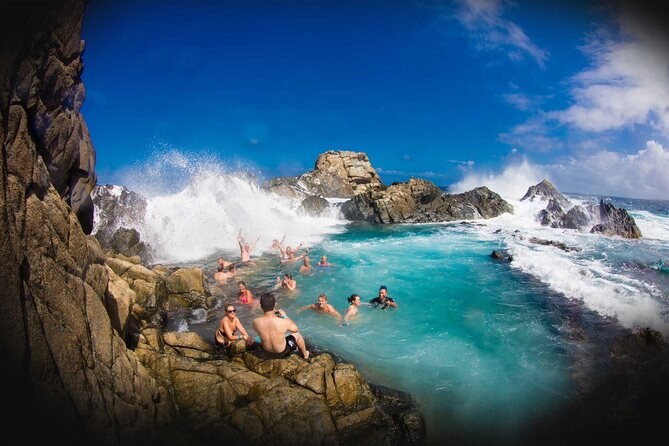
| Conchi (the Natural Pool) | 4x4 rock track | No | The rock pool everybody photographs |
Guided departures for the last row
This is the part worth two minutes at the hire desk. Aruban car rental routinely excludes unpaved roads from damage cover, and the road to the Natural Pool is the one most often named in the exclusion. That means damage out there is yours, in full, with no insurer behind you.
The excess on a hire car is usually several times the price of a seat on a guided jeep, which is the whole argument in one sentence. Read the clause at the desk rather than at the junction, where there is a sign reading 4X4 NAT-POOL and an arrow and a temptation.
San Fuego, almost always. It is the main entrance, it has the visitor centre, and the paved road into the park starts from it. Vader Piet on the southern edge opens half an hour later, closes half an hour earlier and has no visitor centre; it makes sense only if you are already down near San Nicolas or Baby Beach.
The two are twelve kilometres apart by road, so choosing the wrong one is a genuine mistake rather than a rounding error. The map page has the driving times from Oranjestad, Palm Beach and the cruise terminal.
US$22 per adult for the conservation pass, free for under-17s, reduced for residents of Aruba, Bonaire and Curaçao with a government ID. One pass covers the whole park for the day: both caves, every beach, every trail and Conchi if you can get there. There is nothing to book in advance and nothing further to pay inside.
Bring cash. Card is generally accepted at the desk but it is a small building on an unlit road, so carry cash and the question never arises. The fees page has the whole picture.
All of the marked routes. The Cunucu Arikok loop runs about three kilometres past a restored farmstead and takes roughly two hours. Sero Jamanota to the Masiduri viewpoint is about three and a half kilometres and an hour to an hour and a half, and it gives you both coasts from the top. Short loops leave from the visitor centre and take twenty to forty minutes.
The one to walk with company rather than alone is Rooi Prins, which runs down a dry watercourse over loose rock with no obvious line in places. The trails guide has the distances, and the honest note that none of them has any shade at all.
Three to four hours for the caves, Boca Prins and Dos Playa with proper stops. Five to six if you add a walk. You are constrained at the front by the gate opening at eight and at the back by admission closing in the early afternoon, so it is a morning activity rather than something to fit around lunch.
At the marked areas, and only at those: the park's board is explicit that you stay on park roads and use the indicated parking facilities. There is space at the visitor centre, at each cave, above Boca Prins and at the Conchi parking area, and each is a short walk from the thing it serves.
The 20 km/h limit applies throughout and it is not decorative — the roads are narrow, the goats are unbothered by traffic and the surface changes without warning. Off-road driving is the behaviour that got quad bikes and side-by-sides banned in 2020, so the enforcement here has history behind it.
Legally, yes: bicycle is on the park's own list of permitted ways in. Practically it is a serious undertaking, because there is no shade anywhere, the trade wind blows hard across the open interior and the graded surfaces are loose. Nobody sells a guided cycling day into the park, which tells you something.
If you want to move under your own power here, walking is the better answer and the routes are already marked. The trails guide has them.
Two things, and it is worth being straight about both. The first is Conchi, which is the half of the park you cannot reach. The second is the guiding, which matters more here than at most attractions because the things worth seeing are small and camouflaged — the burrowing owls in particular are found rather than seen, and the history of the drawings and the gold veins is on no signboard.
You can close most of that gap by reading the wildlife page and the caves page before you go. It is a substitute rather than a replacement, and it is a perfectly good one.
Arriving too late. Everything else here is recoverable — wrong shoes, no cash, the wrong gate — but a barrier that has stopped admitting is the end of the day, and the published hours are earlier than the rounded figures most travel sites carry. Treat the early afternoon as the cut-off and you will never meet it.
The second mistake is treating the graded road as a suggestion. It is not: the surface changes at a signed junction, the exclusion in your rental agreement is real, and the recovery options at the far end of that track are limited to whoever comes past next.
When Conchi is the point, when nobody in the party wants to drive, or when you would rather somebody else read the road. Aruba national park tour start at seventy-eight dollars for a seat, and several include the conservation pass, which narrows the gap further than the headline figures suggest. The things-to-do page sets out what each half of the park holds.
Yes, for most of it. The paved and graded roads from the San Fuego gate reach both caves, Boca Prins, Dos Playa and Jamanota in an ordinary car. The 4x4 track to the Natural Pool is the exception, and it is usually excluded from rental insurance.
No. The park banned ATVs on 1 June 2020 and UTVs on 31 October 2020, on the strength of an environmental impact survey. Car, jeep, bicycle and on foot are the permitted ways in. The UTV page explains what that means for a booking.
US$22 per adult, free for under-17s, and a reduced rate for residents of Aruba, Bonaire and Curaçao with a government ID. It covers the whole park for one day and is bought at the gate.
Twenty kilometres an hour, posted on the board at the entrance along with the rest of the rules. Staying on the roads and using the marked parking is the other half of the same rule, and it is why the tracks are still passable.
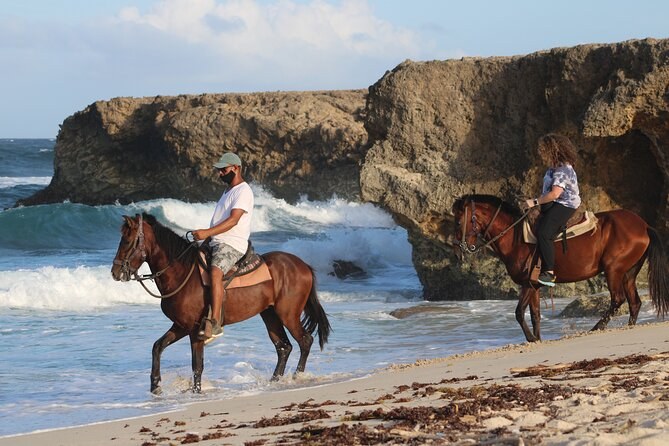
Yes — on foot is one of the three permitted ways, along with horseback and 4x4. It is a long walk in full sun with no water on the route, so do it with a guide or not at all. The Natural Pool page covers all four approaches.
Book a seat. Guided jeeps start at seventy-eight dollars, several include the conservation pass, and the guide handles the track. The decision guide sorts them by how long each spends inside the park.
Drive the graded half yourself and book the rest. Every departure is listed on Arikok National Park Tours.
From $99 per person
From $115 per person