Inside Arikok National Park: Every Cave, Bay and Viewpoint Worth the Detour
Short answer. Two caves, one rock pool, a dune field, twin bays and the highest point on Aruba, and all of them sit on two roads. Take them in the order the road takes them: Quadirikiri and Fontein first while the light is in the caves, then Boca Prins, then Conchi. Half of it is drivable in an ordinary car.
Arikok National Park is thirty-four square kilometres and everything worth stopping for is on two roads. Here is each place, what it actually is, and what it costs you in time.
Quadirikiri Cave
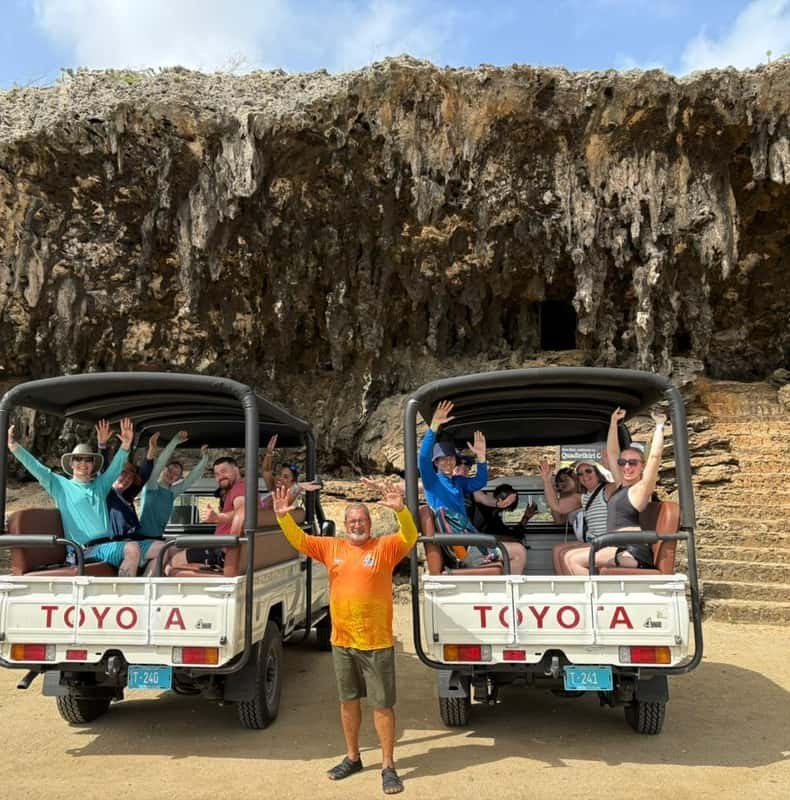
Quadirikiri Cave is the photographed one. Two large chambers open off the entrance and holes in the roof of the first drop shafts of daylight straight onto the sand floor, which is why every itinerary that reaches it schedules it for the middle of the day. A staircase runs up to the mouth. Behind the lit chambers the passage runs back into darkness and that is where the bats are — small, asleep and entirely harmless.
Time it costs: ten to twenty minutes on a guided day, half an hour if you are driving yourself and want the photographs.
Fontein Cave
Fontein Cave is the historic one, ten minutes further on. Caquetío people drew on its ceiling in red-brown pigment before European contact and the drawings are still there, low enough to see without a torch. They are the oldest human record on Aruba. A shallow freshwater pond sits inside, and small fish in it will nibble at feet left in the water — which, judging by the reviews, is what most people talk about afterwards rather than the art.
Time it costs: fifteen to forty-five minutes. The caves page compares the two properly.
Boca Prins and the dunes
A wedge of pale sand between two headlands with a wooden staircase down to it, and behind it a field of sand dunes blown inland over centuries. The dunes are the one landscape on Aruba that reads as desert rather than coast, and they photograph better than the beach does. You do not swim here: the swell arrives unbroken and the undertow is strong.
Time it costs: ten minutes on most guided days, an hour if you walk the dunes.
Dos Playa
Two bays split by a rock spur, north of Boca Prins, with higher cliffs behind them and coarser sand. It is the most dramatic view on the windward coast and the least swimmable. One of the long walking routes ends here from the interior, which is the best way to see it. The beaches page covers the quieter coves beyond it.
Time it costs: ten to fifteen minutes as a photo stop.
Conchi, the Natural Pool
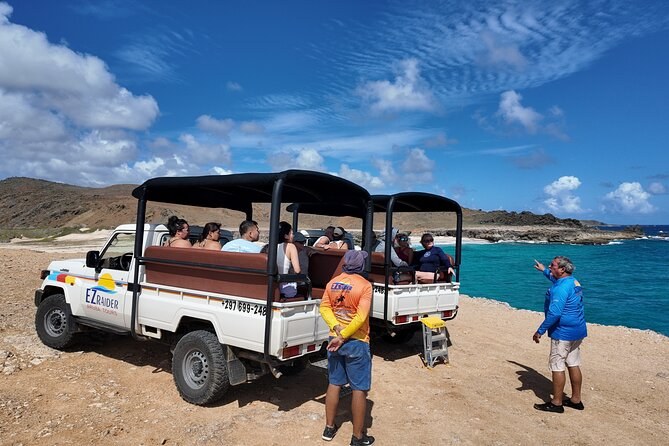
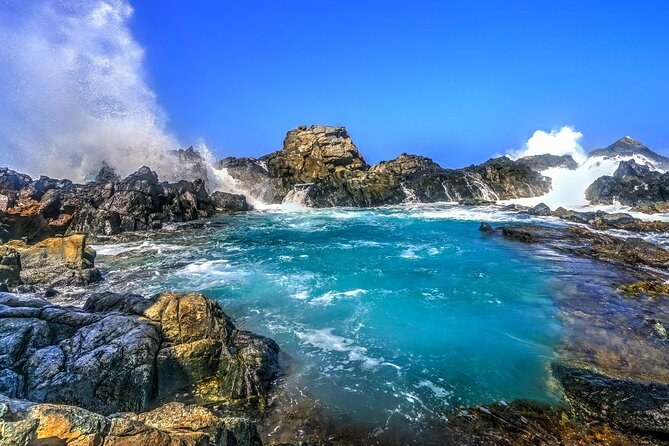
Conchi, the Natural Pool, is a rock basin perhaps twenty metres across, walled off from the open Caribbean by a natural rampart the swell breaks over. The rock around it is pillow lava, formed underwater when the island's oldest formation was laid down. About ninety-three steps drop from the parking area to the water. It is reachable on foot, on horseback or by 4x4, and by nothing else.
Time it costs: twenty minutes to a full hour depending on the departure, and that spread is the single biggest difference between the tours.
Jamanota
At 188 metres it is the highest point on Aruba, and from the top you see the windward and leeward coasts at once. You can drive most of the way or walk up in about an hour from the visitor centre side. Most guided jeep days skip it entirely, which is a reason to give the park a second morning on your own.
Time it costs: an hour on foot, fifteen minutes by road.
Cunucu Arikok
A restored smallholding of the kind Aruban families farmed on this land before it was protected, on the trail of the same name. It is the only built human thing inside the park that is not a sign, and the loop around it takes about two hours on level ground. The trails guide has the routes.
The order to take them in
The road runs in this order anyway, which is why almost every guided itinerary follows it.
| Order | Place | Why here | Roughly |
|---|---|---|---|
| 1 | San Fuego gate | Pass, map, toilets | 10 minutes |
| 2 | Quadirikiri Cave | The roof light is best mid-morning | 20 minutes |
| 3 | Fontein Cave | Ten minutes further along the same road | 30 minutes |
| 4 | Boca Prins | The dunes before the wind builds | 30 minutes |
| 5 | Dos Playa | Photo stop from the cliff | 15 minutes |
| 6 | Conchi | 4x4 only past this point | 45 minutes |
The places most itineraries skip
Three parts of the park almost never appear on a guided day, and all three are worth a second morning in a hire car. Daimari sits at the end of a track north of Dos Playa and is where the wild donkeys tend to be. Boca Keto and Boca Fluit are smaller coves further along the same coast, on rougher ground, and they appear on no listing in the set. Masiduri, inland, has a cunucu house from the 1950s and the remains of an experimental garden on the dry bed of the Rooi Taki.
None of them is spectacular in the way Conchi is. What they are is empty, which on an island receiving a million visitors a year is its own kind of rare.
What the ground under all of it is
The park sits on three rock formations laid down in sequence. The Aruba Lava Formation is the oldest and it formed underwater, which is why the rock around Conchi is pillow lava. The Aruba Batholith intruded through it later, and it carries the quartz veins that were mined for gold in the nineteenth century. The limestone terraces on top are the youngest, and they are what the caves are cut into and what the coast is stepped in.
That sequence is legible from a moving jeep once you know it: rust-red and dark in the interior, pale grey and stepped at the coast. It is also why the walking is harder than the gradients suggest — limestone terrace is sharp and loose underfoot in a way that gentle contours disguise.
What you can reach without booking anything
- Both caves — graded road, ordinary car.
- Boca Prins and the dune field — graded road.
- Dos Playa — graded road.
- Jamanota — graded road most of the way.
- The walking trails — on foot from the visitor centre.
- Not Conchi. That is the one that needs the jeep.
The animals come free. Blue-tailed cododo lizards sit on every wall, wild goats and donkeys use the roads, and the shoco — Aruba’s endemic burrowing owl — is genuinely findable early and late. The wildlife page has what to look for.
How much of it you can fit into one morning
More than you would think, because nothing here is far from anything else. From the San Fuego gate you can be inside Quadirikiri in twenty minutes, at Fontein ten minutes after that, and above Boca Prins ten minutes later again. Add Conchi and the morning becomes a full four hours, because the track out and back takes an hour of it by itself.
What that means in practice is that you should decide before you leave whether Conchi is in your day. With it, you are on somebody else's timetable in somebody else's vehicle. Without it, you have the pass, your own car and a morning that ends when you decide it does.
Take the list above and you have a good half day for the price of the pass. Add Conchi and you need a vehicle that can get there, which is what None exist to solve.
Take them in road order and a half day covers more than you expect. Every departure is on Arikok National Park Tours.
Departures that reach the places on this list
Aruba: Arikok National Park Jeep Safari
Park pass includedSnorkel gearLocal guide
From $109 per person
Half Day Hike at Arikok National Park & Snorkel
Park pass includedTransport includedSnorkel gear
From $115 per person